


|
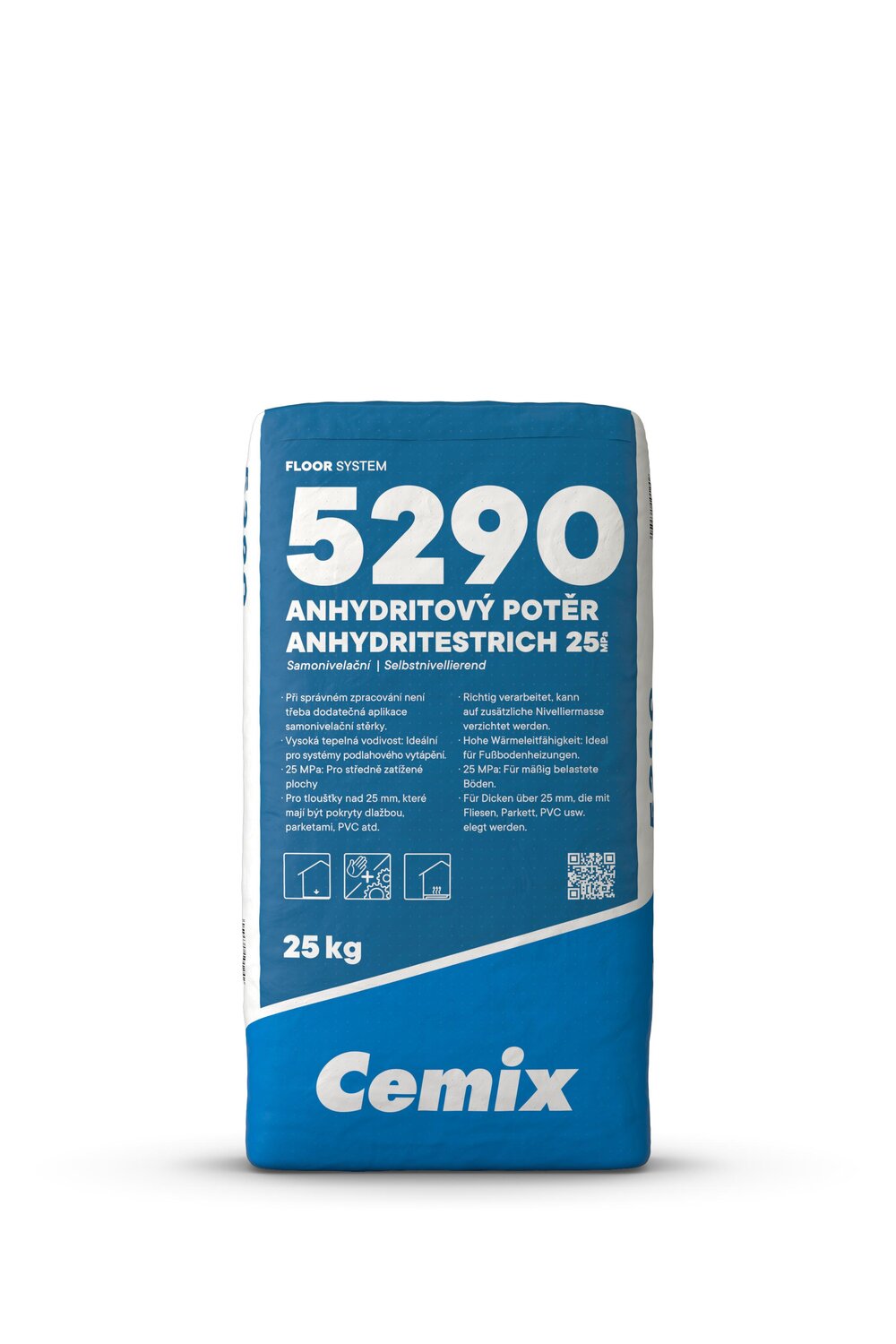


5290
ANHYDRITE SCREED 25MPa
Formerly 090
Hassle free screed laying
Self-leveling screed properly processed makes leveling compound unnecessary.
- Calcium sulfate screed for creating floating and bonded indoor screeds.
- Self-levelling: easy to use.
- Shrinking- and crack-free.
- High thermal conductivity: particularly well suited for underfloor heating systems, without using additional reinforcement.
- For application thicknesses over 35 mm to be covered with tiles, parquet, laminates, PVC, carpets, etc.
- 25MPa: For moderately loaded areas in residential and office premises
Area of application
- Indoor: floor
Heating and cooling area
- Floor
Processing method
- For hand and machine processing
- For the construction of floors with or without underfloor heating with high load requirements in the interior (in the construction of apartments, offices, administrative buildings, hotels, schools, etc.).
- Creation of floating and combined (connected) screeds for laying floor coverings (tiles, parquet, floating floors, PVC, carpets, etc.).
Contact

Loading...
Processing details
Learn more about technical details for processing this product.
Substrate requirement
The substrate must comply with the applicable standards, must be solid, free of loose particles, free of dust, paint, residues of demoulding substances and efflorescence. It must be sufficiently rough, dry and evenly absorbent. The surface shall not be frozen or water-repellent. The substrate must be stable in volume.
Substrate preparation
A bonded layer: Before applying the screed to the old concrete, the substrate must be moistened and treated with Cemix primer 5400.
Floating layer: Separate the substrate with a suitable separation layer e.g. PE 0.2mm. Thermal and acoustic insulators must be stacked together without gaps. Working or structural joints must be respected and must be created perimeter dilatation of vertical building elements (walls, pillars, pipes, etc.). The substrate must comply with the applicable regulations, standards or recommendations of the material manufacturer.
Preparation of the mixture
Pour the dry mixture into the prescribed amount of water and mix with a slow-speed mixer. Stir to a homogeneous mixture without lumps and leave to rest. Then mix again briefly. Use suitable machinery, e.g. SMP FE 100, for machine processing.
Water demand

| Quantity | Liters (Min) | Liters (Max) |
|---|---|---|
| 25 kg | 3,7 l | 4,3 l |
| 1 kg | 0,15 l | 0,17 l |
Mixing


Mixing time
5 min
Mixing speed in Rpm
800x/min
Ripe time
3 min
Processing instructions
Before application, check the spread using the Hägermann-Trichter method, which should be 230-250 mm. Pour the mixed mixture in a single layer to the desired height. Then level and deaerate using vibrating rods. In narrow profiles (e.g., doors between rooms) or in rooms where the aspect ratio is greater than 1:3, expansion joints must be made. If a very smooth surface is required (under cork, PVC, etc.), sand the floor and coat it with a fine self-leveling trowel with a thickness of 1-3 mm. Apply the product when the outside temperature and water temperature are above 5°C and the inside temperature is above 10°C.
Application thickness
| Minimum layer thickness | 15 mm |
|---|---|
| Recommended layer thickness | 45 mm |
| Maximum layer thickness | 100 mm |
Consumption
Material consumption min.
1.8
Material consumption max.
-
Material consumption in measuring unit
Kg/m²/mm
Working time (potlife)

60 min
Walkability after

24 h
Treatment after application
Avoid the negative effects of sun, heat, humidity and draughts. Protect from frost and rain. Direct heating of the surface is prohibited.
Conditions after laying anhydrite screed
1. Air temperature and humidity during curing
o It is recommended that the relative humidity (RH) of the air be around 50–70% and the room temperature 10–25 °C.
o Immediately after laying, the temperature should not be too low or too high, and there should be no drafts or direct sunlight.
2. First phase of curing ("stabilization") – first 24–48 hours
o The screed should be kept calm, without vibrations or disturbances.
o Moisture loss should not be too rapid; it is recommended to prevent drafts and aggressive air currents.
o After this period, windows can be opened for moderate ventilation and air exchange.
3. Ventilation and dehumidification
o Dehumidifiers can be used 72 hours after installation to help speed up drying.
o High relative humidity in the room slows down drying — it is good to maintain good ventilation.
o The relative humidity (RH) of the air should not exceed 75% and the room temperature should be between 10 and 30°C.
4. Underfloor heating (if applicable)
o If there is underfloor heating in the screed, it can be turned on after about 7 days to speed up the drying process.
o Increase the temperature gradually: by about +5 °C per day, up to the recommended maximum operating temperature (e.g., 50–55 °C).
o Maintain this maximum temperature for 3 days and then slowly reduce the temperature by 5 °C per day back to approx. 15–20 °C.
o Before measuring moisture (e.g., for laying floor coverings), turn off the heating for ~48 hours.
5. Removal of "laitance" (surface fine layer)
o During the hardening of anhydrite, a weak surface layer (called laitance) is formed, which is not suitable for bonding floor coverings.
o This layer must be removed mechanically – e.g., by lightly sanding with a rotary sander with coarse sandpaper (e.g., 60 grit).
o Vacuum the dust thoroughly after sanding.
6. Checking the moisture content of the screed before laying the covering
o Before laying the floor covering, it is necessary to verify that the moisture content of the screed is sufficiently low in accordance with EN 13892-10 Test methods for screed materials - Part 10: Determination of moisture content - Calcium carbide method.
7. Protection against moisture penetration
o The screed must be protected against rising damp by horizontal waterproofing and also from above, e.g., against rain if the building is open, or against other sources of water.
o If moisture gets back into the screed, it can significantly slow down the drying process or disrupt curing, thus affecting the final parameters of the screed.
Tool and cleaning instructions
Wash off tools with water immediately after finishing work. Clean dried residues mechanically.
Technical parameters
| Main binder | Gypsum |
| Flammability class | A1fl |
| Max. grain size | 4mm |
| Full load after | 7 d |
| Compressive strength 28 days in N/mm² | 25 N/mm² |
| Flexural strength 28 days in N/mm² | 6 N/mm² |
| Thermal conductivity λ in W/(m.K) | 1.25 |
| Dry bulk density in Kg/m³ | 1900 |
| Dry bulk density in Kg/m³ to | 2200 |
| Wet density in Kg/m³ from | 1900 |
| Release of corrosive substances | CA |
Download
|
|